Thursday, 25 May 2017

De Stijl

DE STIJL


This blog is for academic purposes in the partial fulfilment of ACHG 200 Assignment 1 at the Design Department, Pearson Institute of Higher Education.

De Stijl,  Dutch for "The Style", also known as neoplasticism, was a Dutch avante garde founded in 1917 in Leiden. The De Stijl consisted of artists and architects. In a narrower sense, the term De Stijl is used to refer to a body of work from 1917 to 1931 founded in the Netherlands(Katheryn M, 1994). They simplified visual compositions to vertical and horizontal, using only black, white and primary colours.

HISTORY

De Stijl movement embraced an abstract, simplified aesthetic culture in basic visual elements such as geometric forms and primary colours. The reduced quality of De Stijl art was seen by its makers as a universal visual language that would better suit the modern era. Led by the painters Theo van Doesburg and Piet Mondrian, De Stijl artists applied their style to a body of work in the fine arts(the Artstory,2016). 

The members envisioned nothing less than the ideal fusion of form and function, a Utopia of Modern art, this making De Stijl ,in the eyes of the pioneers, the ultimate style. De Stijl artists turned their attention not only to fine art media such as painting and sculpture, but to all other art forms as well, including industrial design, typography, even literature and music(Tate, 2006).

The pioneers involved in De Stijl are:

Ilya Bolotowsky (1907–1981)
Burgoyne Diller (1906–1965)
Theo van Doesburg (1883–1931)
Cornelis van Eesteren (1897–1981)
Jean Gorin (1899–1981)
Robert van 't Hoff (1887–1979)
Vilmos Huszár (1884–1960)
Frederick John Kiesler (1890-1965)
Antony Kok (1882–1969)
Bart van der Leck (1876–1958)
Piet Mondrian (1872–1944)
Marlow Moss (1889–1958)
J. J. P. Oud (1890–1963)
Gerrit Rietveld (1888–1964)
Kurt Schwitters (1887–1948)
Georges Vantongerloo (1886–1965)
Friedrich Vordemberge-Gildewart
Jan Wils (1891–1972)

Historical Artwork


Composition with Red, Blue, and Yellow by Piet Mondrian (WikiMedia, 2015)

This was one of the De Stijl Artwork titled Composition with Red, Blue and Yellow by Piet Mondrian one of the founders of the De Stijl movement made this artwork embodying the simple style of there Utopian idea of bringing elements to there simplest form and style.The primary colours inside the blocks as well as the straight lines and white blocks show harmony and order with in the art work.

Modern Artwork

(Vans,2010)
These Piet Mondrian inspired shoe designs made by Vans using the complete and ultimate style of De Stijl of Harmony and order also using the functionality of designing a useful item to be used by the viewer.

Conclusion

De Stijl has showed me to refer back to things in there original form and not to forget about originality and simplicity.

Sources

http://madamepickwickartblog.com/2010/08/mondrian-theosophically-painting-the-golden-calf/

"Piet Mondrian", Tate gallery, published in Ronald Alley, Catalogue of the Tate Gallery's Collection of Modern Art other than Works by British Artists, Tate Gallery and Sotheby Parke-Bernet, London 1981, pp.532–3. Retrieved 18 December 2007.

http://www.theartstory.org/movement-de-stijl.htm

"De Stijl". Tate Glossary. The Tate. Retrieved 2006-07-31.

Linduff, David G. Wilkins, Bernard Schultz, Katheryn M. (1994). Art past, art present (2nd ed.). Englewood Cliffs, N.J.: Prentice Hall. p. 523. ISBN 0-13-062084-X.

http://www.tate.org.uk/art/art-terms/d/de-stijl

http://emptyeasel.com/2007/10/23/the-de-stijl-art-movement-also-known-as-neo-plasticism/


Constructism

Constructivism

This blog is for academic purposes in the partial fulfilment of ACHG 200 Assignment 1 at the Design Department, Pearson Institute of Higher Education.

Constructivism is a philosophical viewpoint about the nature of wisdom and knowledge. Specifically, it represents a political and belief stance between the Russian White Army and the Red Army (Jean Piaget, 1967). It evolved just as the Bolsheviks came to power in the October Revolution of 1917, and was a lightning rod for the hopes and ideas of many of the most advanced Russian artists who supported the revolution's goals (The Artstory, 2017).

HISTORY

Earlier educational philosophies did not place much value on what would become constructivist ideas; children's play and exploration was seen as aimless and of little importance. (Jean Piaget, 1967)

The views of Constructivism were more focused on human development in the context of the social world are favoured and include the sociocultural or socio-historical perspective of Lev Vygotsky and the perspectives of Jean Lave and Etienne Wenger (Lave, 1991).

The concept of constructivism has influenced a number of disciplines, including psychology, sociology, education and the history of science (Eddy, 2004).

"The artist constructs a new symbol with his brush. This symbol is not a recognisably form of anything which is already finished, already made, already existing in the world - it is a symbol of a new world, which is being built upon and which exists by way of people." El Lissitzky

Writers who influenced constructivism include:


John Dewey (1859–1952)
Maria Montessori (1870–1952)
Władysław Strzemiński (1893–1952)
Jean Piaget (1896–1980)
Lev Vygotsky (1896–1934)
Heinz von Foerster (1911–2002)
George Kelly (1905–1967)
Jerome Bruner (1915–2016)
Herbert Simon (1916–2001)
Paul Watzlawick (1921–2007)
Ernst von Glasersfeld (1917–2010)
Edgar Morin (1921–)
Humberto Maturana (1928–)

Historical Artwork


Beat the Whites with the Red Wedge by El Lissitzky (The Artstory, 2016)

This is a very historical poster by El Lissitzky which was a propaganda poster which he used o evoke emotion to the people of Russia about the political state of Russia concerning the social and belief system, it implies that we beat the Whites with the Red wedge which was the Red Army against the political White army.

Modern Artwork

 (bloodline242, 2010)
This modern artwork by a group called Bloodline242 was a show poster advertising the event that took place. This poster embodies styles of the constructivism movement in terms of not creating art for the sake of creating art but creating art with a purpose and a functionality. In this case the posters functionality was to advertise the event.

Conclusion

Constructivism movement helped me as a designer not to create artwork with no functionality and all are work i create must have a purpose and a goal of evoking emotion of people and viewers to have opinions about the artwork as well as their own views about the artwork.

Sources

Jean Piaget, 1967

Lave, J. & Wenger, E. (1991). Situated Learning: Legitimate Peripheral Participation. Cambridge University Press.

Eddy, Matthew Daniel (2004). "Fallible or Inerrant? A Belated review of the "Constructivist Bible"". British Journal for the History of Science. 37: 93–8. doi:10.1017/s0007087403005338.

http://www.theartstory.org/artist-lissitzky-el-artworks.htm#pnt_2

http://www.arthistoryarchive.com/arthistory/constructivism/

http://bloodline242.jugem.jp/?eid=1569


Friday, 28 April 2017

SURREALISM

SURREALISM

This blog is for academic purposes in the partial fulfilment of ACHG 200 Assignment 1 at the Design Department, Pearson Institute of Higher Education.


Surrealism is an avant-garde movement that began in the early 1920s that released the creative potential of the unconscious mind which made paintings seen or placed together with a contrasting effect (juxtaposition).

HISTORY

This movement started around 1920's in Europe after World war 1. It combined elements of Dada and cubism to create something new to the world. Poets and writers however were the first people to have it out in the world. However André Brenton is known as the "Pope of Surrealism." (Charles Moffat, 2011).

André Brenton explained surrealism as "psychic automatism in its pure state by which one proposes to express - verbally, by means of the written word, or in any other manner - the actual functioning of thought." This meant that most artists went over the reasoning and phobia of getting their unconscious mind (The Art Foundation, 2017). Later on, these techniques became automatism  that made artists forgo conscious thought and embrace chance when creating art (The Art Foundation, 2017).

"The Interpretation of Dreams" was one of the most influential books to the surrealists in 1899. This book was written by Sigmund Freud who justified the importance  of dreams and the unconscious as valid revelations of human emotion and desires hence a basis for theoretical Surrealism thus each artist doing their paintings basing on their own recurring dreams or/and unconscious mind (The Art Foundation, 2017). 


Main artists involved in this movement were:
-Andre Breton (1896-1966) -Antonin Artaud (1896-1948)
-Joan Miro (1893-1983)
-Salvador Dali (1904-1989)
-Pablo Picasso (1881-1973)
-Max Ernst (1891-1976)
-Marcel Duchamp (1887-1968)
-Giorgio de Chirico (1888-1978) -Rene Magritte (1898-1967)
-Yves Tanguy (1900-1955)
-Frida Kahlo (1907-54) among others. 


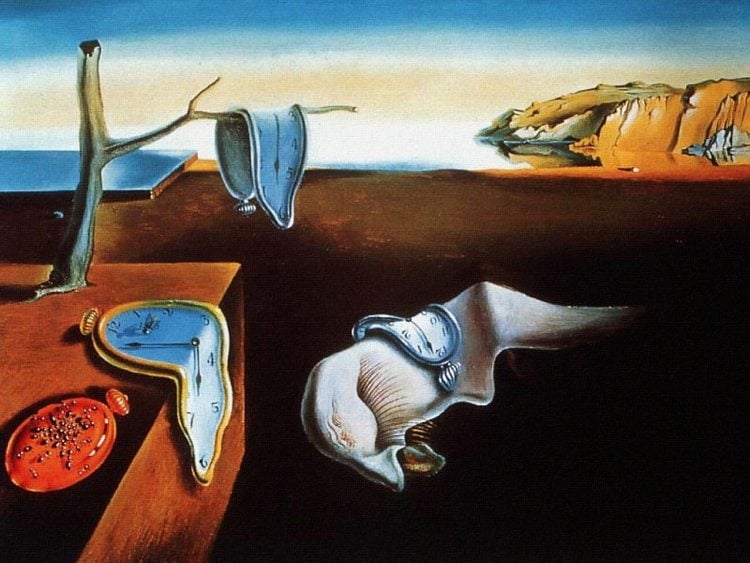
The Persistence of Memory by Salvador Dali (Mamta Bhatt 2016).

This is the most famous or well known painting in the history of Surrealism. It is the iconic ode to time according to Salvador. His inner workings of subconscious are reflected by the dripping clocks and also show that time as we know it is meaningless.

MODERN PAINTING.

(Jacek Yerka, 2012)
The above painting is by Oleg Shuplyak and was done in 2011. In this painting, you get to see different series of compositions forming one beautiful face on a landscape. The houses on the right with the trees form a face  which is also the left eye of the the main face in the painting. The woman on the left with a child kneeling form the left eye and lastly the a woman in the center with a man playing a harp and a tree forming the mouth and nose.
According to my view, the painter tried to reflect the sadness because of a breakup thus the woman in the center and on the left woman with a child on the left. He shows a sad man that tries to hide his face hence looking at the back playing his harp.
So he displayed his message properly.


CONCLUSION

In conclusion, Surrealism has helped me as a graphic designer to be creative through unconsciousness and making it real through illustrating. This has also also made me more creative in the world of design since there is no limit or restrictions of art.


SOURCES

Charles Moffat, 2011. Art History Archive.The Origins of Surrealism. Online. Available at:
http://www.arthistoryarchive.com/arthistory/surrealism/Origins-of-Surrealism.html
Accessed on: 28/04/2017

The Art Foundation, 2017. The Art Story. Surrealism. Online. Available at:
http://www.theartstory.org/movement-surrealism.htm
Accessed on: 28/04/2017

Mamta Bhatt 2016. All that is interesting. Surrealism Art: Seven Iconic Surrealist Artists and Paintings. Online. Available at:
http://all-that-is-interesting.com/most-iconic-surrealist-paintings
Accessed on: 28/04/2017

Jacek Yerka, 2012. Cuded. 20 Inspirational Surreal Paintings. Online. Available at:
http://www.cuded.com/2012/10/20-inspirational-surreal-paintings/
Accessed on: 28/04/2017


Monday, 17 April 2017

DADAISM


This blog is for academic purposes in the partial fulfilment of ACHG 200 Assignment 1 at the Design Department, Pearson Institute of Higher Education.

History

Dada means 'hobbyhorse' or the exclamation "Yes-Yes" (Artyfactory, 2017).
It all started in February 1916 at a city's Cabaret Voltaire in Zurich where a group of artists that were opposing the cultural values that led to the World War 1 (David K., 2015).
There were a number of artists associated with this movement and there were:-
-Hugo Ball
-Tristan Tzara
-Marcel Janco
-Richard Huelsenbeck
-Jean (Hans) Arp
-Raoul Hausmann
-Hannah Höch
-John Heartfield
-Kurt Schwitters
-Johannes Baargeld
-Johannes Baader
-Max Ernst
-George Grosz
-Hans Richter
-Francis Picabia
-Man Ray
-Marcel Duchamp.


Dada challenged the political, social and cultural values of that time, the elements of music, art, dance among others were embraced. It created a climate in which art values were unrestricted hence anti-art.Dadaists had automatism, chance, photomontage and assemblage as their techniques. It then later influenced the development of Surrealism, Action Painting, Pop Art, Installations, Happenings and Conceptual Art (Artyfactory, 2017).


Historical painting

MAX ERNST (1891-1976)
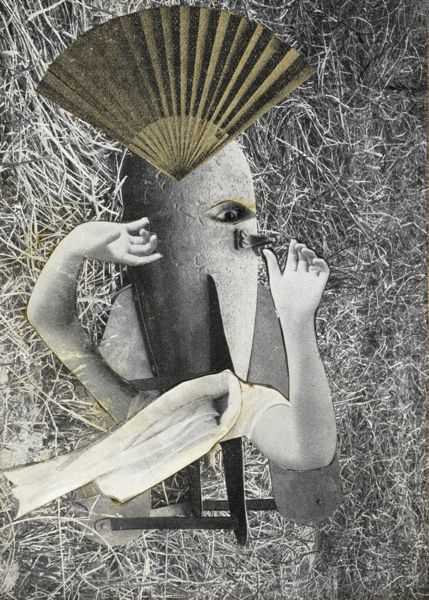
'The Chinese Nightingale' 1920 (photomontage)
The above image is a photomontage called the 'The Chinese Nightinggale' and was done by Max Ernst in 1920. Ernst created a visual poetry from unconscious associations of juxtaposed images (Artyfactory, 2017). So basically his style was more of a collage whereby he combined human limbs  of a woman, with a fan and a bomb below them, a terrified eye   hence he communicating something. So his main intention with this image was defusing  the natural fear of bombs as seen in above.


Modern painting


Victoria Rick, 
2014.


The above image is by Victoria Rick and is a photomontage.You can see that it was cut out of different pieces to come up with a story for example, the people in the bottom left side of the image are sitting on a street bench, then there is a library being left side, the center shows ancient buildings likely to be in London and a man walking. According to me, this image what happens in London as a city.


Conclusion

In seeing what this movement did, it has helped me as a designer to be able to communicate my artwork in a strong and very effective  way for example use of a collage to come up with what I feel and can be seen and understood by the viewers.


Sources

David Koenig, 2015. The Dada Movement. Online. Available
https://www.dadart.com/dadaism/dada/020-history-dada-movement.html
Accessed on 16/04/2017

Artyfactory, 2017. The Dadaism. Online. Available
http://www.artyfactory.com/art_appreciation/art_movements/dadaism.htm
Accessed on 16/04/2017


Victoria Rick, 2014. Playing with dimensions. Online. Available
https://victoriarick.wordpress.com/category/photomontage/
Accessed on 16/04/2017


Thursday, 6 April 2017

EXPRESSIONISM

Expression is the action of making known ones's thoughts or feelings.

HISTORY

This movement started around 1905 -1925. So expressionism was a term used to indicate or show the use distortion and exaggeration for emotional effect or look and feel. So in other wards, artists here did not depict objects the way they were but what they thought or felt according to them emotionally (Administration, 2017).
There was judgment of work since artists at this era made paintings from there emotional points of view instead from what they saw physically. This made their paintings become more of the artist's character expressed with feelings rather than analyzing compositions (The Art Story, 2017).

There were two manifestos and these were:

1. Die Brucke
This was a German expressionism formed in Dresden around 1905 (Art Story, 2017). So their paintings were more of figurative distortions, they also worked directly on the image and chose color according to the mood they were in and lastly worked aggressive on the brush strokes whilst using un naturalistic colors to the canvas .

2. Der Blaue Reiter
This started from Munich in German as an abstract counterpart to Die Brucke's distorted figurative style. His paintings were mainly focusing on the idea that color and form had concrete spiritual values. So he also had a paintings that expressed the way felt and saw music hence showing his unique approach to form (The Art Story, 2017).

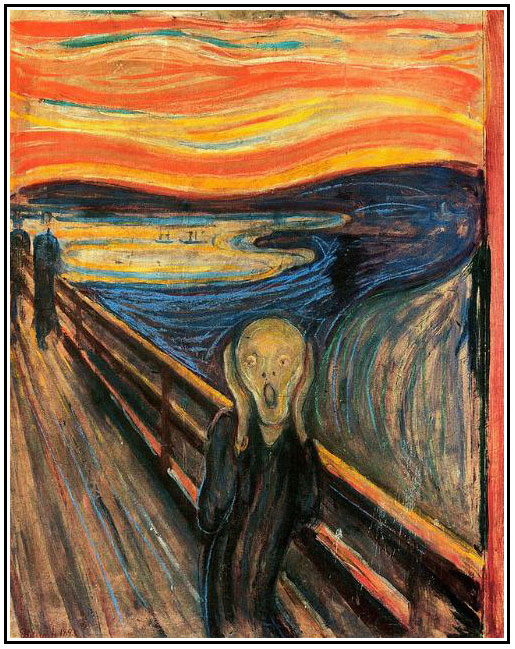
"THE SCREAM" BY EDVARD MUNCH, 1893 

This is a painting done by Munch called "The Scream." When you look at the painting, it shows his emotions in a way that you see an alien like person terrified and screaming on the bridge. The painting is also exaggerated in way of his style of drawing whereby  it involves swirls especially as seen in the sky and the water.

Modern painting.

Painting by Ford Smith 2010-2016
The painting above is done by Ford smith. In this painting , you can see that he is inspired by the expressionism movement expressing the the tree leaves in a circular form, and also the handling brush strokes in the sky in whilst form. The colors of his painting done depending on his mood hence this being a modern painting of expressionism.


Sources
Administration, 2017. Art movements. Online.Available at:
http://www.artmovements.co.uk/expressionism.htm
Accessed on: 06/04/2017

The Art Story, 2017. The Art Story: Expressionsm. Online.Available at:
http://www.theartstory.org/movement-expressionism.htm
Accessed on: 06/04/2017

The Art Story, 2017. The Art Story: Der Blaue Reiter. Online.Available at:
http://www.theartstory.org/movement-der-blaue-reiter.htm
Accessed on: 06/04/2017

The Art Story, 2017. The Art Story: Der Blaue Reiter. Online.Available at:
http://www.harmonyangels.com/Expressionism.html
Accessed on: 06/04/2017


Friday, 31 March 2017

FUTURISM

History

Futurism deals with events that are anticipated to come in the future.
This movement started in the early 20th century and it emphasized  speed, dynamism, energy, the strength of the machine and the vitality, and modernity. 
In this movement, visual arts and poetry were were the most significant (John James White, 2015).
This all started in Italy 1909 when Filippo Tommaso Marinetti published his first manifesto 'Futurist Manifesto.' Umberto Boccioni, Gino Severini, Giacimo Balla and Carlo Carra were drawn by Marinetti's ideas because of belief of being translated into modern, figurative art which handled and explored features of movement and space(Wolf. J, 2017).


Characteristics
- Futurists had their paintings evoking all kinds of sensations that were not only visible to the   eye.
- Futurism borrowed various aspects of Post-Impressionism, which were Symbolism and         Divisionism adhering working in an eclectic manner hence making it not being identified
  with a distinctive style.
- They used the new visual technology which influenced them in their paintings hence 
  showing movement in painting, and use of abstract art with rhythmic palpitating qualities
  (Wolf. J, 2017).
- Most ideas from this movement where generated through writing  and several manifestos.


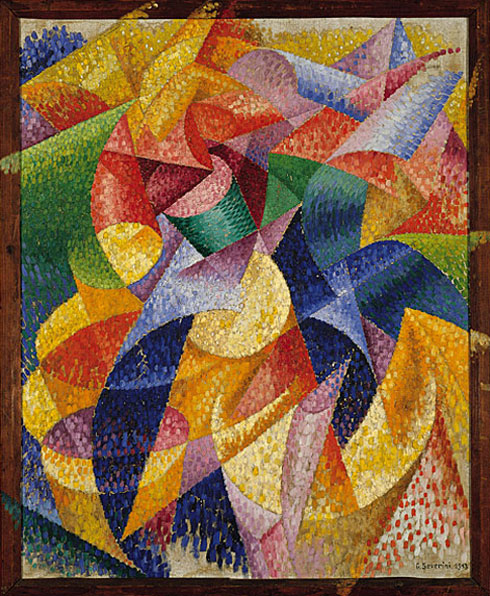
Sea Dancer, Gino Severini, 1913

The above painting is called the Sea Dancer, and as seen above it is broken light and colour into series of dots and also geometric forms using a style of divisionism.


Modern painting


Above is a painting of a woman or man sitted in the chair with his or right hand relaxed up the chair.
It is a futurist painting because of the  geometric shapes used the use of colour and the overall painting is more of abstract at first sight but as you look at it closer you get to see understand it.

In conclusion, futurism has helped us to think of the future which today is often seen in movies like Iron man where things shown in a futuristic way hence expressing futurism.


Sources consulted
John James White, 2015, Global Britannica. Online. Available at:
https://global.britannica.com/art/Futurism
Accessed on:30/03/27

Wolf. J, 2017, The Art story: Futurism. Online. Available at:
http://www.theartstory.org/movement-futurism.htm
Accessed on:30/03/27

Colluna, 2017, Design is History. Online. Available at:
http://www.designishistory.com/1850/futurism/
Accessed on:30/03/27


Monday, 13 March 2017

CUBISM

History

In the early 20th century, this movement influenced most visual art styles. The major people who created this movement were Pablo Picasso a Spanish man (1881-1973) and a French man by the names of Georges Braque (1882-1963).
These artists broke the concept that art should copy nature for example they did not adopt or follow the the traditional techniques of perspective (Sabine Rewald, 2004).

Key ideas/ Characteristics.

-In this period, artists broke the traditions of art. These are the rules of perspective that depicted space  since renaissance. 
-The artists explored different types of form for example space would flow through sharp figures and  objects.
-These cubists used non-art materials. These were abstract structures that were produced in paintings.
-Cubism paved way for the non-object of school and sculpture (The Art Story, 2017).


Cubist example 

Les Demoiselles d'Avignon 1907. (Pablo Picasso.org, 2009)


This painting was done by Pablo Picasso and is the most known example of cubism. Here Picasso broke the traditional representation of art with renaissance period. He portrayed the female bodies in form of distortion and geometric forms in a creative way, which challenged the beliefs of females representation of beauty. In this painting, African art influenced Picass(Pablo Picasso.org, 2009).


Temporary Art

The boxer by Dylan Jones (Chris Spooner, 2007)


The image above is of a boxer as the title says, it breaks the tradition of art in a way there is no perspective and form especially for his adidas short, it is rectangular. In this image the artist used cool and warm colours to differentiate the front from the back for example, for the legs, red was given to the front one whereas dark green is given to the back one.

Conclusions

To me as a designer, cubism paved a way for me to be able to  do what I want today for example, when I can be able to create an abstract painting or picture and has a meaning or representation hence not following the art tradition.
An example is a logo.


Sources.

Sabine Rewald, 2004. Cubism. Online. Available at:
http://www.metmuseum.org/toah/hd/cube/hd_cube.htm
Accessed on: 13/03/2017

The Art Story, 2017. Cubism. Online. Available at:
http://www.theartstory.org/movement-cubism.htm
Accessed on: 13/03/2017

Pablo Picasso.org, 2009. Les Demoiselles d'Avignon by Pablo Picasso 1907. Online. Available at:
http://www.pablopicasso.org/avignon.jsp#prettyPhoto
Accessed on: 13/03/2017

Chris Spooner, 2007. 30 Modern Examples of Cubism Style in Digital Art. Online. Available at:
http://blog.spoongraphics.co.uk/articles/30-modern-examples-of-the-cubism-style-in-digital-art
Accessed on: 13/03/2017